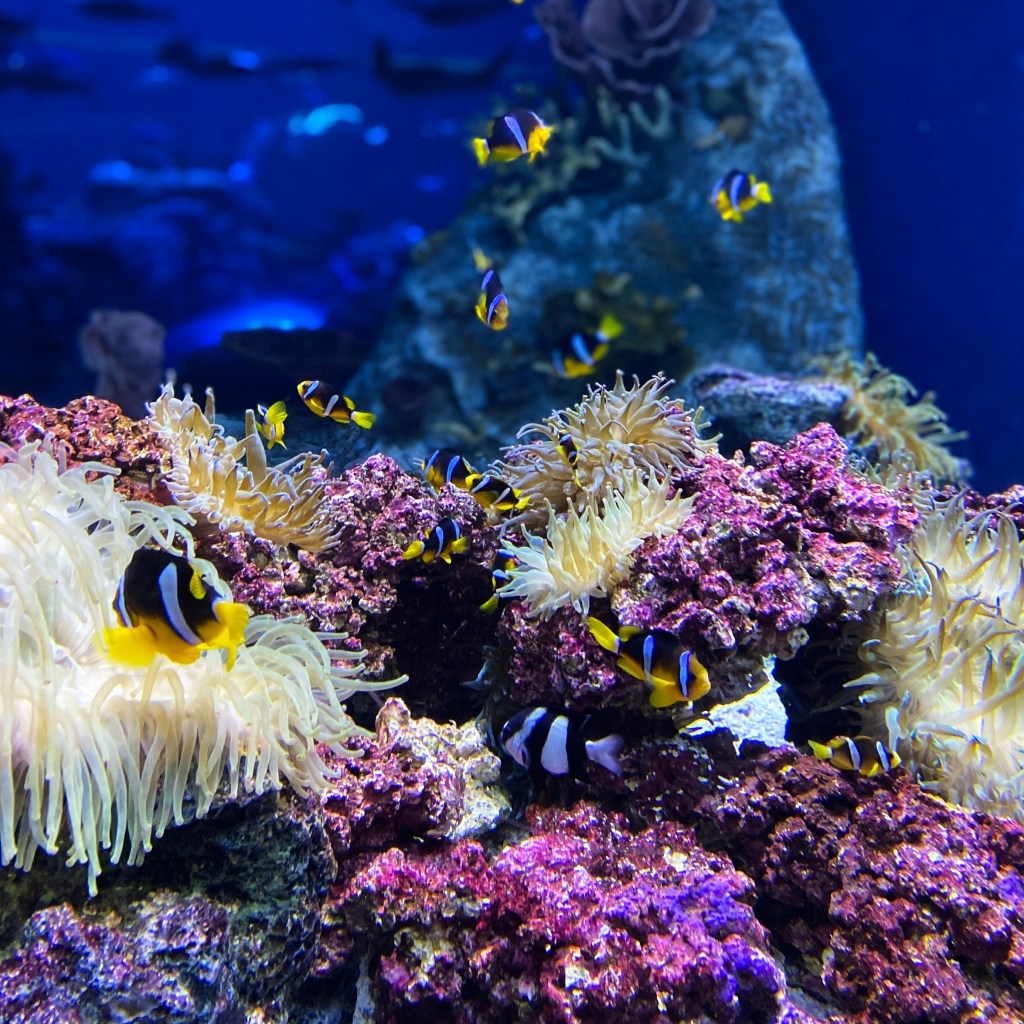
Image by Sunita Fan from Unsplash
Brilliant, bright colors of the rainbow shine everywhere the eye can see—from the fish to the plant life within this coral reef. However, there is a danger lurking in shadows, waiting to wipe out the coral reef and leave only a skeletal graveyard behind. Our focus will be on what coral reefs do, the dangers they face today, restoration and preservation efforts being used to help them, and finally where future efforts should be aimed to keep coral reefs safe.
Coral reefs host some of the most diverse lifeforms in the sea, as well as around a third of all sea species—which is why they are called “rainforests of the sea.” Professor Voolstra, Professor Peixoto, and marine researcher Ferrier-Pagès note in “Mitigating the ecological collapse of coral reef ecosystems” that corals are sessile animals that build three-dimensional structures through their calcium carbonate skeletons, which rival cityscapes. In “Hybrid coral reef restoration can be a cost-effective nature-based solution to provide protection to vulnerable coastal populations,” written by research geologist Dr. Storlazzi and his co-authors, they discuss how coastal flooding and erosion from extreme weather affect thousands of coastal communities around the world, and the effects of coastal hazards are predicted to worsen due to population growth and climate change. Furthermore, according to Storlazzi and his co-authors, coral reefs reduce coastal flooding by absorbing and dissipating 97% of wave energy, protecting coastal communities from extreme weather events and erosion.
Without coral reefs, there is an increased risk of flooding across tropical coasts, just imagine the danger our coastal communities would be in without our coral reefs. This is rather important since, as marine researcher Dr. Rottmueller and her co-authors note in their article titled “Coral reef restoration can reduce coastal contamination and pollution hazards,” there are tons of toxic chemicals that get released into the environment during tropical storms, like gasoline, drycleaning agents, diesel, and sewage. Imagine all that muck free to cover and contaminate as much as it wants during storms without our coral reefs. The benefits of coral reefs do not end with being shields, though. Marine scientist Dr. Cvitanovic and his fellow authors note, in the article “Roadmap for improving coral reef restoration practices in Southeast Asia,” that coral reefs provide a lot of benefits and services, from fisheries to tourism, which are dependent on them. Voolstra and their colleagues state that there are even further uses of coral reefs, from sand production to carbon sequestration.
Despite being so impressive, corals themselves are rather delicate, and thus coral reefs face many challenges today, most of which come from human actions. One of the main challenges facing coral reefs comes from climate change. Marine researchers Baldwin, Gain, and Fritsch state in their article “The Great Barrier Reef, human dimensions and climate change” that increased water temperatures have caused mass coral bleaching, and are projected to decline by a further seventy to ninety percent if global temperatures rise another 1.5°C. Cvitanovic and his fellow authors note that direct human actions such as pollution, urbanization, and fishing are also largely negatively affecting coral reefs. Voolstra and their team stated some other stressors affecting climate change, and therefore coral, were sedimentation, and eutrophication, caused by land clearing and fertilizer use. Marine scientist Hilmi and her co-authors noted in “The pressures and opportunities for coral reef preservation and restoration in the Maldives” that other dangers to coral reefs exist, including disease by fungi, protozoa, and bacteria. However, climate change, pollution, and fishing are recognized as the main dangers to coral reefs.
Professor Hughes and his co-authors in “Principles for coral reef restoration in the anthropocene” describe restoration as re-building populations of species that have been depleted. There are many methods to restore and preserve coral reefs. As Cvitanovic and his colleagues note, conservation and restoration efforts span from mitigating threats to coral reef ecosystems to actively seeking to reverse coral degradation and enhance ecosystem resilience. Marine researcher Alvarado and his co-authors wrote in “Coral reefs restoration initiatives in Costa Rica: ten years building hope” that the first initiatives to restore marine environments was from the 80’s, when an attempt to deploy artificial reefs was made. This method is like one of the other earliest methods of conserving coral reefs, one that is still used today, of which is coral gardening. However, as Hughes and his team notes, coral gardening—the process of transplanting healthy corals to a reef—was deemed too expensive to be a primary method of conservation. Hughes and his co-authors also note that in 2005 the International Coral Reef Initiative (ICRI) said to focus on conservation efforts that remove the causes of reef decline and encourage the natural resilience of coral reefs. Baldwin and his co-authors mention the Reef Restoration and Adaptation Program, which was a plan for the Great Barrier Reef focused on three main areas of reef restoration: cooling and shading the Reef to minimize climate change impacts, assisting species adaptation through means such as coral assisted reproduction, and supporting natural restoration through artificial structures and coral stabilization. Hughes and his fellow authors note a focus on efforts that are trying to increase the amount of wild populations of tropical coral, rather than more controversial approaches such as underwater fans, artificial structures, or electrified substrates.
Along with coral gardening, there are other forms of restoration. Hughes and his team mention that assisted evolution is an umbrella term for many techniques that include selective breeding, hybridization, and genetic engineering. With assisted evolution we could accelerate naturally occurring evolutionary processes by releasing modified coral from a laboratory to the wild. It is thought that by introducing modified genes into a natural environment, we will be able to speed up natural selection in coral. There are some issues with this plan that mainly come from the fact that a laboratory-bred coral may have weaknesses that wild coral has evolved to leave in the past. For example, Hughes and his co-authors note that corals cultivated in aquariums or nurseries generally have weakened skeletons when in comparison with their wild counterparts, and it is unknown if genetically enhanced corals would truly have a greater lifespan than wild coral—the laboratory coral could be weaker to disease, predators, or storm damage. Another restoration idea is interspecific hybridization, which could also be a dangerous idea since there are many hybrid species known to be infertile and weaker than their parents. Furthermore, once hybrid species are released into the wild, there would be no going back in the case it turned out to be a poor decision—much like how coywolves now overrun wolf territory, the hybrid coral could overtake wild coral and choke it out.
However, coral reefs are more resilient than one might think, as they have lasted millions of years through various environmental hazards. And while, as Hughes as his team express, under extreme circumstances, a coral reef formed entirely of hybrid coral would be better than no corals at all, it would be better to help natural coral thrive as much as we can. Many coral restoration efforts don’t seek to restore overall biodiversity to coral species, but instead seek to augment, imitate or force evolve them. The main method of improving conditions for coral reefs, in a way that preserves their biodiversity, is to reduce the pressure on them—reducing pollution, fishing, and climate change pressures. Each coral reef has different pressures, and so one should ask what dangers are affecting each coral reef before attempting to restore it, as each restoration effort should be personalized to each reef. Hughes and his co-authors state that reef restoration is a governance challenge, not just a biological one. He and his team state that setting clear goals, with established controls for comparison, and measuring more appropriate response variables could all significantly improve future coral restoration. However, legislation and policy need to concentrate on bolstering ecosystem resilience by reducing the dangers affecting coral reefs. And, with coral reefs continuing to decline, more institutions are needed to improve the effectiveness of coral reef restoration. One thing that you can do to help coral reefs is to support both policy and management interventions. Successful restoration provides hope, improves environmental agencies, and strengthens complementary conservation strategies. Even when restoration attempts fail, they raise awareness of the danger reefs are in and the urgency of intervening to help stop their decline.
To conclude, our coral reefs hold several uses for humans, such as coastal protection. Unfortunately, they are in grave danger from climate change, pollution, and fishing—among other pressures. There are many restoration and conservation efforts that have been used to help coral reefs in the past, such as coral gardening, but many have been considered too expensive or labor-intensive in the long-term. Therefore, the restoration we must rely on depends on the natural preservation of corals as we seek to remove the specific pressures affecting each coral reef and depends on the collaboration of the government and local bodies to put action to all restoration ideas. In the end, there is hope for our coral reefs, so long as we act immediately.
Bibliography
Alvarado, Juan José, Katharine Evans, Joan A Kleypas, José Andrés Marín-Moraga, Mauricio Mendez-Venegas, Carlos Pérez-Reyes, Marylaura Sandoval, María José Solano, and Tatiana Villalobos-Cubero. “Coral Reefs Restoration Initiatives in Costa Rica: Ten Years Building Hope.” Revista de Biología Tropical 73, no. S1 (March 3, 2025). https://doi.org/10.15517/rev.biol.trop..v73iS1.63695.
Baldwin, Claudia, Animesh K. Gain, and Oliver Fritsch. “The Great Barrier Reef, Human Dimensions and Climate Change.” Australasian Journal of Environmental Management 32, no. 1 (January 2, 2025): 1–5. https://doi.org/10.1080/14486563.2025.2450941.
Cvitanovic, Christopher, Mari‐Ann M. Acedera, Preciosa C. Samonte, Maria Vanessa Baria‐Rodriguez, Patrick Cabaitan, Nguyen Thi Dzung, Nguyen Thanh Binh, et al. “Roadmap for Improving Coral Reef Restoration Practices in Southeast Asia.” Ecological Management & Restoration 25, no. 3 (September 2024): 160–67. https://doi.org/10.1111/emr.12615.
Hilmi, Nathalie, Ritu Basu, Matías Crisóstomo, Lara Lebleu, Joachim Claudet, and Davide Seveso. “The Pressures and Opportunities for Coral Reef Preservation and Restoration in the Maldives.” Frontiers in Environmental Economics 2 (March 17, 2023). https://doi.org/10.3389/frevc.2023.1110214.
Hughes, Terry P., Andrew H. Baird, Tiffany H. Morrison, and Gergely Torda. “Principles for Coral Reef Restoration in the Anthropocene.” One Earth 6, no. 6 (June 2023): 656–65. https://doi.org/10.1016/j.oneear.2023.04.008.
Rottmueller, Marina E., Curt D. Storlazzi, and Fabian Frick. “Coral Reef Restoration Can Reduce Coastal Contamination and Pollution Hazards.” Communications Earth & Environment 6, no. 1 (January 26, 2025). https://doi.org/10.1038/s43247-025-02019-4.
Storlazzi, Curt D., Borja G. Reguero, Kristen C. Alkins, James B. Shope, Camila Gaido-Lassarre, T. Shay Viehman, and Michael W. Beck. “Hybrid Coral Reef Restoration Can Be a Cost-Effective Nature-Based Solution to Provide Protection to Vulnerable Coastal Populations.” Science Advances 11, no. 3 (January 17, 2025). https://doi.org/10.1126/sciadv.adn4004.
Voolstra, Christian R, Raquel S Peixoto, and Christine Ferrier‐Pagès. “Mitigating the Ecological Collapse of Coral Reef Ecosystems.” EMBO reports 24, no. 4 (March 2, 2023). https://doi.org/10.15252/embr.202356826.
 Science Writings