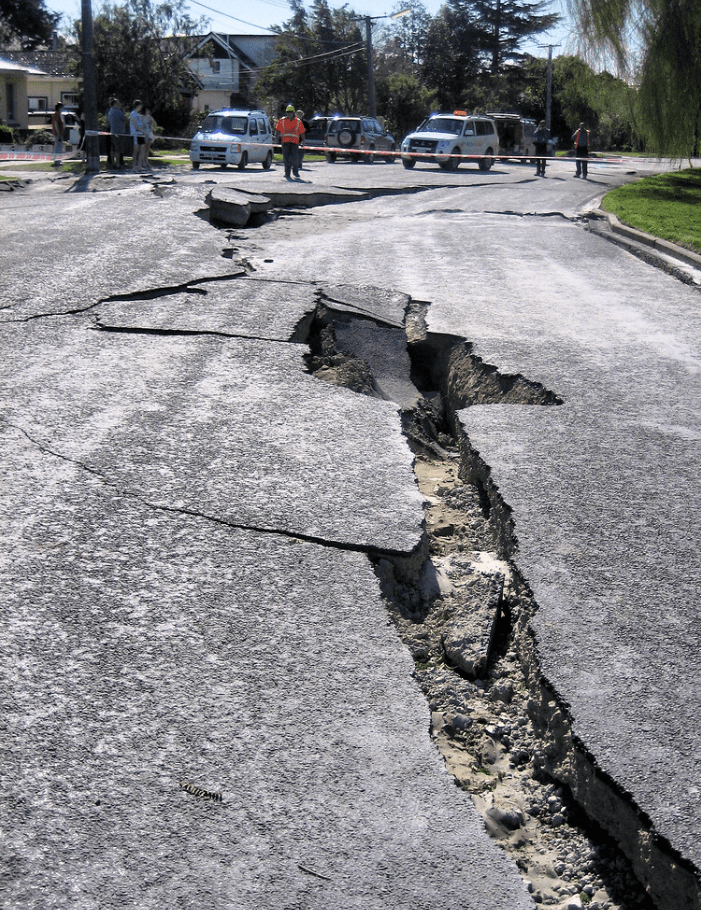
Earthquake damage-road by martinluff is licensed under CC BY-SA 2.0
Well, “perfect” is definitely impossible to attain, but Kathryn Schulz provides valuable insight into how to write scientifically with the audience in mind. Anyone who knows me as a writer will know that I am a raging perfectionist. If my work doesn’t turn out exactly how I want it, in the exact way I see it, then I’m not happy. I’m constantly looking for ways to improve how I write, and I found a few bits of information that’s worth noting in Kathryn Schulz’s “The Big One.” After a close read and in-depth annotation, there are three key takeaways that I found in order to improve my writing and further my skills.
The first detail that Schulz employed well is personability. There are narrative elements and a few funny interjections in the masses of earthquake jargon that keep the audience grounded and help them digest the information. The first page opens with a narrative-style story about where the main researcher was at the time of the earthquake, which sets the scene and indicates the reader-friendliness of the piece. Later, in the pages’s last paragraph, there’s a quick, explicit interjection that’s humorous because it’s out of place in a scientific article.
When I write, there are times when I find myself wrapped up in wanting to sound smart and sophisticated, but I end up confusing myself and others who read my work. The audience slips to the back of my mind, and I don’t realize it until I go back and read it myself. I want to be better at remembering to include those personable details to help keep the audience engaged. An engage audience is an audience that will better retain information.
The second takeaway is more of a negative one, and it involves the connection of ideas. I made an annotation on page four where I say the topic sentence of the paragraph that starts with, “The Pacific Northwest sits squarely within the Ring of Fire” is misleading. There wasn’t any mention of the PNW before that point, and it threw me out of my reading groove and made me think, “Why are we changing topics? What is this?” It was abrupt and unneeded, in my opinion. The paragraph directly after that does the same thing, and if I was confused, I’m sure others who read the passage were as well.
This is a lesson in the importance of idea connection for the sake of flow and understanding. As a reader, I love a piece that makes me feel as if I’m floating down a river, not crashing across a tidal wave. This section reinforced the importance of properly connecting ideas with topic sentences instead of just jumping from one idea to the next without warning. That connection needs to be established sooner.
The final takeaway I want to focus on is the explanation of scientific processes. This is done well on the sixth page. The last two sentences of the first full paragraph explains how Goldfinger and his team were able to collect data about one of the subduction zones by “…counting the number and the size of deposits in each sample…” among other procedures. This is especially important in science writing because the general audience won’t know the intricacies of the field. If the goal is to inform, then steps like that need to be taken to ensure that happens. Schulz does a good job of exploring this topic in depth, which is what all scientific writers should strive to do.
 Science Writings