
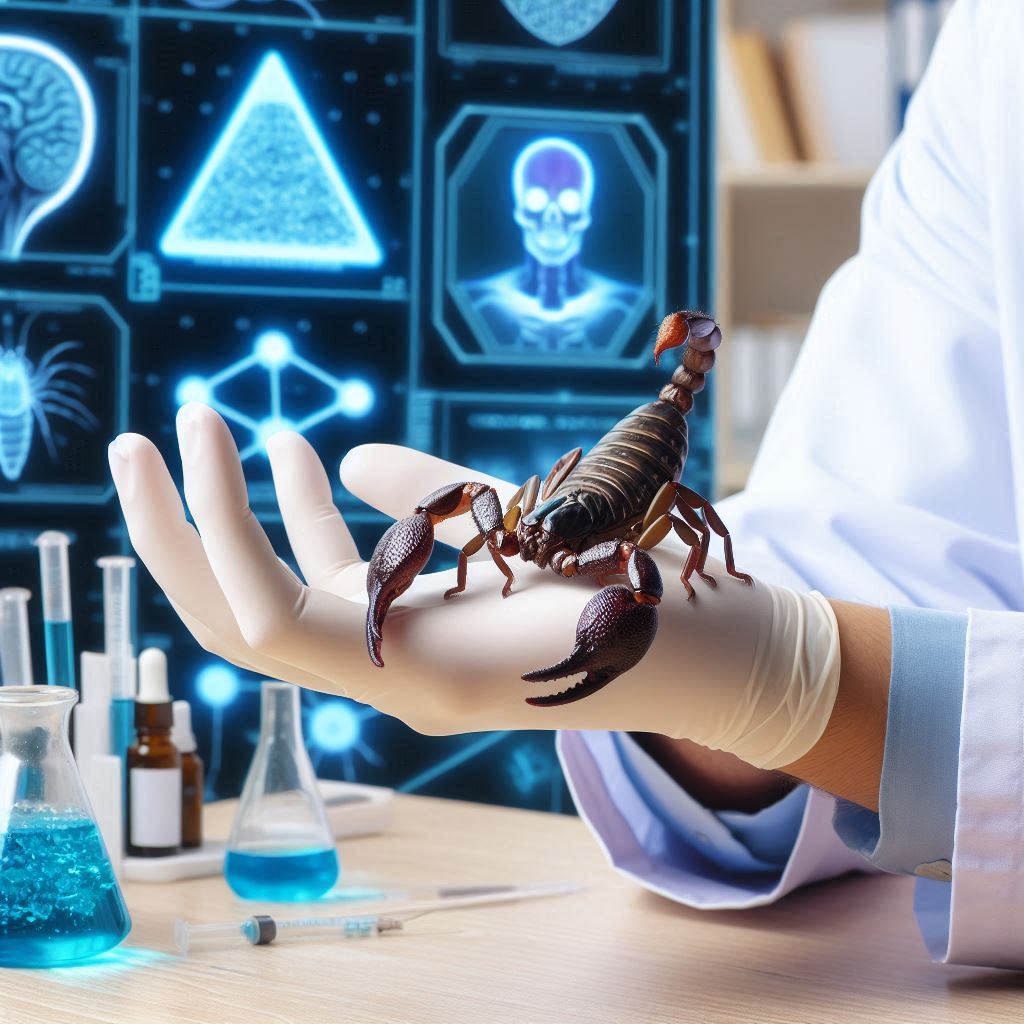
Imagine this: you’re out on a warm summer’s night, far from civilization, with no light pollution to obscure the breathtaking view of the Milky Way. You set up a tarp and sleeping pad, ready to enjoy the serene beauty as you drift off to sleep. But a few hours later, you wake with a jolt, feeling a sharp, excruciating pain in your hand. Congratulations—you’ve just been stung by a scorpion.
Lucky for you, this is just a hypothetical scenario. For me, however, it actually happened. While camping on the Havasupai reservation, a branch of the Grand Canyon in Arizona, an Arizona Bark Scorpion stung my left pinky while I slept. Ouch! I’d never been stung by a scorpion before, and I had no idea what to do. (Remember, I was out in the middle of nowhere, in a reservation that has no roads and still gets its mail by pack mule.)
I sought out one of the members of the Havasupai. Imagine my surprise when he told me not to worry about it. “It’s just a scorpion sting,” he said. “You’ll be fine.” That shocked me. We’ve all heard of scorpions—they have quite the dastardly reputation—but the man was right. I waited it out. It still hurt for a few hours, but it eventually went numb, and I couldn’t feel my hand for nearly a week! Naturally, when I got home, my research began. How was it that I’d been so ignorant?
The Truth About Scorpions
It turns out I’m far from the only uninformed person when it comes to scorpions. I got stung nearly a decade ago. In that time, I’ve told hundreds of people my story. Almost every time I tell it, people are shocked to learn the truth about scorpions: they aren’t nearly as dangerous as everyone makes them out to be. Since beginning my research, I’ve learned a wide variety of facts. For instance, the scorpion that stung me is just one species of over 1,500. Of all the different varieties, mine was the most venomous species in the country! Similarly, I’ve learned that deaths are rare—really rare!
Scorpion Venom: What You Need to Know
In an article posted on Bannerhealth.com, author Regan Olsson shares that of all the species of scorpions found in the United States, only one has a potent enough toxin to “produce severe toxic symptoms to your nervous system – though most people stung by one can be safely managed and observed at home.” Just like in my case, the vast majority of people stung will experience pain, but nothing in the “life-threatening” department. That said, younger children, older adults, and those allergic are much more susceptible to dangerous side effects after a sting.
Naturally, that doesn’t mean that we should wander around picking up scorpions! The sting still packs a powerful punch, trust me! Just because a venom isn’t as deadly as you thought doesn’t make it worth experiencing. On that note, I can’t help but feel a few readers already starting to ask, “What about the babies? I’ve heard they’re more deadly than the adults!” Don’t worry, Olsson covered that topic too. Simply put, “the age of the scorpion doesn’t dictate if the venom is more dangerous than the venom of an adult.” Note, however, that the size of the species may help you identify danger levels.
Scorpion Size and Potency
Fans of Harrison Ford will remember a line from the movie “Indiana Jones and the Kingdom of the Crystal Skull.” At one point, the main character Indy comes across several crawling scorpions and says, “When it comes to scorpions, the bigger, the better.” Well, according to an article on Science.org titled “When it Comes to Scorpions, it’s the Small Ones You Need to Watch Out For,” it turns out there is a correlation between a scorpion’s potency and its size—just not when it’s the same species. That means that a small bark scorpion isn’t any more potent than a large one, but another, smaller species, may be. Keep in mind, however, that this isn’t a hard and fast rule. The Deathstalker Scorpion, for example, can grow several inches longer than an Arizona Bark Scorpion, and it’s considered the most dangerous scorpion in the world!
Scorpion Encounters: How Likely Are They?
All this scorpion talk raises the question: how likely are you to have a scorpion encounter? You may find the answer surprising. While the Arizona bark scorpion is mostly confined to desert regions, other species of scorpions can be found across the US. Even some of the more northern states like Washington, Idaho, and Montana have them! To see just how far their range extends, I looked up a map on Inaturalist.com, a website where people can take pictures and record their findings in the natural world. Don’t take my word for it, though; have a look at the map below. Each red box represents an area where a scorpion sighting has occurred!

See how some places are darker than others? Those are the areas you really want to watch out for. In my hometown of Saint George, Utah, for example, it isn’t uncommon for some households to find dozens of scorpions in their yard or homes in a single night! A few years after I was stung, I set out to learn more about scorpions firsthand. Through social media, I found a friend who claimed to have a constant scorpion problem in her home. Turns out she wasn’t kidding! I went to her home armed with a set of tongs and a bucket. Forty minutes later, I’d successfully found and captured twenty-six scorpions! Similarly, just last week, I spoke with another individual who spots them regularly. “I end up killing anywhere from 100 to 300 every single year!” the man told me. “It’s sad, but when it comes down to it, I’ve got kids, and I don’t plan on letting them get stung.”
Scorpion Distribution and Habitat
Scorpions are incredibly adaptable and can be found in a variety of environments—from the hottest deserts to tropical rainforests. Here in the U.S., scorpions are most commonly found in the southwestern states, but as I mentioned earlier, they can be found as far north as Washington and Montana.
A survey published in the journal “PLOS ONE” looked at the global distribution of scorpions and the factors that influence their habitats. The study found that temperature and humidity are the main factors determining where scorpions can live. In colder places, some species have developed ways of surviving, like burrowing and going dormant during harsh conditions to survive.
Understanding Scorpions: Anatomy and Behavior
Now that I’ve shared how prevalent scorpions can be in certain areas, let’s dive into the fascinating world of these intriguing arachnids. As it turns out, scorpions aren’t all that different from spiders, ticks, and mites. In fact, they’re actually distant cousins of the eight-legged creatures we often find in our basements. They are instantly recognizable with their eight legs, a pair of pincers (called pedipalps), and a segmented tail that ends with a venomous stinger.
Many stings, including my own, happen at night because scorpions prefer to sleep during the day. They venture out at night, using their pincers to capture and crush their prey, while their stinger delivers venom to subdue meals or defend against predators. Unfortunately, this sometimes leads to accidental encounters with humans. Despite their fearsome reputation, scorpions are fascinating creatures with unique adaptations that have helped them survive for hundreds of millions of years.
One of the coolest of these adaptations is their ability to glow under ultraviolet (UV) light. You might have seen this in nature documentaries or even tried it yourself with a UV flashlight. This eerie glow is due to substances found in their exoskeleton. Scientists are still unsure of the exact purpose of this fluorescence, but some theories suggest it could help scorpions detect light, communicate with each other, or confuse predators. No matter its purpose, we humans have found the fact incredibly helpful in using it to help us spot them!
Scorpion Encounters: Prevention and First Aid
So how likely are you to run into one of these nocturnal wanderers? While encounters are relatively rare, they can still happen, and it’s always best to be prepared. Simple preventive measures can go a long way in avoiding a sting. For starters, shaking out shoes and clothes, especially if you’ve left them outside or in a garage, can help keep them off your body. Likewise, when your living areas are free of clutter, scorpions have a fewer places to hide. Finally, in areas where scorpions are common, you can almost always find a company that can help you exterminate them. Remember how I said you can use UV light to find them? Many extermination companies do that! As it turns out, one of the most effect ways to stop a scorpion infestation is to simply collect and dispose of them.
But what if you do get stung? First, don’t panic. According to the Mayo Clinic, here’s what you should do:
1. Clean the wound: Use soap and water to clean the sting site to prevent infection.
2. Apply a cool compress: This can help reduce pain and swelling.
3. Take pain relievers: Over-the-counter medications like ibuprofen or acetaminophen can help manage the pain.
4. Seek medical attention: If symptoms worsen or if the person stung is a young child, elderly, or has known allergies, get to a doctor immediately.
Conclusion
Scorpions are often misunderstood and feared, but they are fascinating creatures with unique adaptations that have helped them survive for millions of years. While their venom can cause significant discomfort and, in rare cases, severe reactions, most scorpion stings are not life-threatening. Increased awareness and understanding of these arachnids can help reduce unwarranted fear and promote coexistence with these remarkable creatures.
Further research into scorpions and their behavior continues to uncover new insights with potential applications in medicine and biology. As we demystify the scorpion, we transform fear into fascination, revealing nature’s intricate wonders lurking just beneath the surface.
 Science Writings