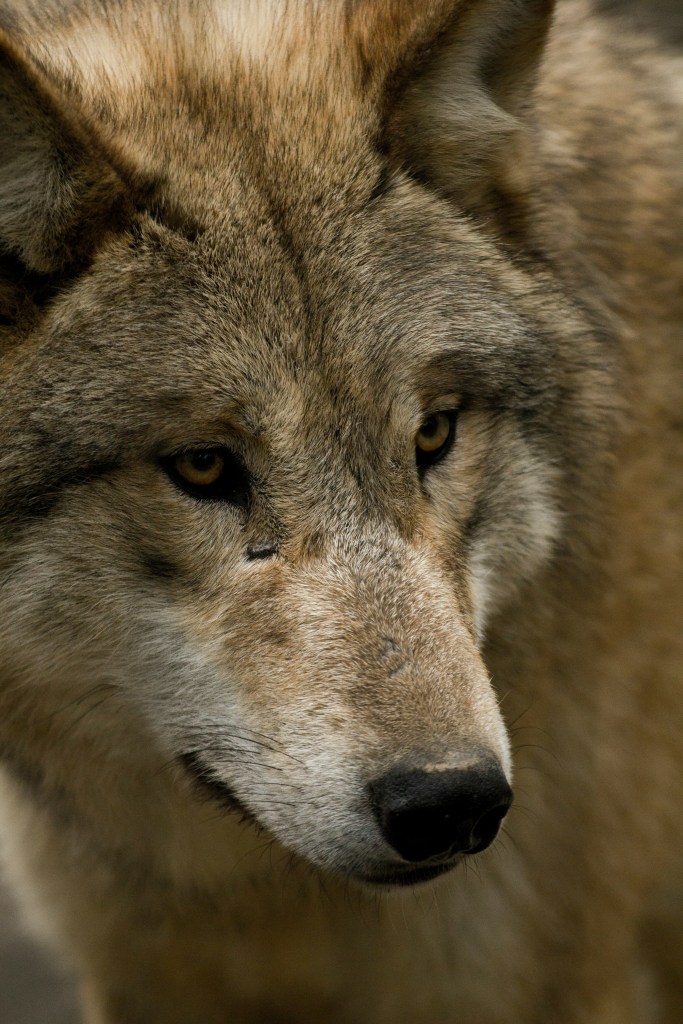
Wolf in Zurich Zoo, Switzerland by Simon Infanger on Unsplash
Deep within the densely packed Amazon rainforest three green birds with different colored feathers on their heads may be found—but only two of these birds have been recognized as true species. The discrepancy is due to a natural hybridization between the two species, opal-crowned and snow-capped manakins, resulting in a uniquely presenting third bird breed.[1] Discovering the existence of this hybrid species has added to the belief that hybridization in wildlife has been occurring for thousands of years longer than we first believed. However, a pressing matter is the mystery behind how hybridization between species is gaining momentum as natural environments continue to be affected by human actions, and how hybrids will affect the future of our planet.
Around 2010 was when we not only started to see an increase in the number of naturally occurring hybrids, but scientists noticed that natural hybrids have existed for longer than originally believed. The newest occurring hybrids are polar bears with brown bears, and wolves with coyotes. In the past, however, most natural hybrids occurred amongst plants with animal hybridization occurring later.[2]
Since the hybridization of wild animals is still new to general research there is a large gap in what is known about them versus their parent species. Originally, it was believed that animals from various species only started mating due to displayed similarities and the loss of individuals within their natural species to partner with. However, the discovery of a hybrid offspring between a rose-breasted grosbeak and scarlet tanager contradicted this hypothesis since the two birds having striking differences from one another in appearance and are possibly separated by over 10 million years of divergent evolution.[3] The reason for the hybrid offspring is still unknown, displaying the mysterious origin and nature of wild hybrids.
Still, the idea that human action is the cause behind the growth in hybrid appearance remains a solid theory. As forests are razed to be turned to farmlands, grasslands dug up and developed into residential neighborhoods, and toxic gases continue to be released into the atmosphere we must recognize the effect our actions as humans have on natural habitats and the wildlife within them.[4] These changes to our world are what have caused wildlife to lose their home, grow endangered, and start overlapping territory with similar species. Unfortunately, endangered species may only be in further danger from hybrid offspring.
Hybridization can lead to an overall negative result to the primary species that resulted in them, such as in cases where the hybrids may end up outperforming their parents for food and territory. Red Wolves, which are critically endangered, have hybrid offspring known as “coywolves” which are further threatening the restoration progress of their species.[5] Joseph W. Hinton and his fellow researchers, in their article “Size-Assortative Choice and Mate Availability Influences Hybridization Between Red Wolves and Coyotes,” discovered that female Red Wolves that live in smaller territories are more likely to breed with male coyotes due to their similar body sizes, especially when compared to male Red Wolves. Since male coyotes are smaller, the female wolves see them as more desirable mates to share their already limited territory with. Unfortunately, there is danger for Red Wolves both from how the hybrid offspring reduce the amount of pure-bred Red Wolf offspring being bred, and in how coywolves are often more territorial and mean than their parents.[6]
While a hybrid offspring may be stronger than their parents, the hybrid could end up much weaker than them. In their article “Interspecific Hybrids of Dwarf Hamsters and Phasianidae Birds as Animal Models for Studying the Genetic and Developmental Basis of Hybrid Incompatibility,” Satoshi Ishishita and Yoichi Matsuda reported their findings that it is more probable for hybrids to have issues the more their parents are genetically separated from one another. Since animals must have some relation to one another to have viable offspring—offspring that can survive outside of their mother or egg—Ishishita and Matsuda’s findings make perfect sense. Essentially, the less two species are related, the less likely their offspring are to thrive.
Each species inherits specific biological instructions through their DNA, but hybrids end up with a combination of two DNA instructions meshing.[7] Related to what Ishishita and Matsuda’s research found, the mixture of distinct DNA processes is what often leads to hybrids having notable health problems and ending up sterile. One example of a genetically weak hybrid is the liger, which has many medical issues such as organ failure, neurological deficits, and many more. Although a hybrid may be able to function physically the split of their instincts provided by their parents may instead lead to their downfall. For instance, while the russet-backed thrush and the olive-backed thrush have the same destination they have separate migration routes and the hybrid offspring of the two birds often flies a strange mixture of the two routes.[8] Mixing the two routes meant that the hybrid offspring were often flying the path of most resistance and missing critical resources their parents would stop at in their own journeys.
Another reason is that hybrids may not survive where their parents would be due to their coloration or shape.[9] Animals have evolved to be shaped and present the colors necessary for their survival, but hybrids often look distinct from both parents. In terms of camouflage this is especially dangerous for the hybrid offspring, who cannot hide from predators as their parents can. In terms of shape, hybrid children may not be able to avoid predators the way their parents are able to.
There are many reasons that hybrids may not survive, but that does not mean that all-natural hybridization is to be looked on as a bad sign. In many ways we must recognize that our world is constantly changing around us, in no little part due to our own efforts, and it is no surprise that animals are changing to keep up with it. We are not capable of getting rid of hybrids now that they have appeared, and it is likely that more are going to continue to be discovered across the earth, so we must take this time to learn, get used to, and work with these new creatures we share our world with.
[1] Kwok, Roberta. “The Mixed-up World of Hybrid Animals.” Science News Explores, December 5, 2019: 1. https://www.snexplores.org/article/mixed-world-hybrid-animals.
[2] Adavoudi, Roya, and Małgorzata Pilot. “Consequences of Hybridization in Mammals: A Systematic Review.” Genes 13, no. 1 (December 24, 2021): 1, 7. https://doi.org/10.3390/genes13010050.
[3] Bittel, Jason. “Ligers, Zorses, and Pizzlies: How Animal Hybrids Happen.” National Geographic, October 10, 2022. https://www.nationalgeographic.com/animals/article/ligers-zorses-pizzlies-how-animal-hybrids-happen.
[4] Ellington, E. Hance, and Dennis L. Murray. “Influence of Hybridization on Animal Space Use: A Case Study Using Coyote Range Expansion.” Oikos 124, no. 5 (February 19, 2015): 535. https://doi.org/10.1111/oik.01824.
[5] Bohling, Justin H., Justin Dellinger, Justin M. McVey, David T. Cobb, Christopher E. Moorman, and Lisette P. Waits. “Describing a Developing Hybrid Zone between Red Wolves and Coyotes in Eastern North Carolina, USA.” Evolutionary Applications 9, no. 6 (June 2016): 801. https://doi.org/10.1111/eva.12388.
[6] Ellington, “Influence of Hybridization on Animal Space Use,” 539.
[7] Kwok, “The Mixed-Up World of Hybrid Animals,” 2.
[8] Kwok, 5-6.
[9] Kwok, “The Mixed-Up World of Hybrid Animals,” 6-7.
Bibliography
Adavoudi, Roya, and Małgorzata Pilot. “Consequences of Hybridization in Mammals: A Systematic Review.” Genes 13, no. 1 (December 24, 2021). https://doi.org/10.3390/genes13010050.
Bittel, Jason. “Ligers, Zorses, and Pizzlies: How Animal Hybrids Happen.” National Geographic, October 10, 2022. https://www.nationalgeographic.com/animals/article/ligers-zorses-pizzlies-how-animal-hybrids-happen.
Bohling, Justin H., Justin Dellinger, Justin M. McVey, David T. Cobb, Christopher E. Moorman, and Lisette P. Waits. “Describing a Developing Hybrid Zone between Red Wolves and Coyotes in Eastern North Carolina, USA.” Evolutionary Applications 9, no. 6 (June 2016): 791–804. https://doi.org/10.1111/eva.12388.
Ellington, E. Hance, and Dennis L. Murray. “Influence of Hybridization on Animal Space Use: A Case Study Using Coyote Range Expansion.” Oikos 124, no. 5 (February 19, 2015): 535–42. https://doi.org/10.1111/oik.01824.
Hinton, Joseph W., John L. Gittleman, Frank T. van Manen, and Michael J. Chamberlain. “Size‐assortative Choice and Mate Availability Influences Hybridization between Red Wolves (Canis rufus) and Coyotes (Canis latrans).” Ecology and Evolution 8, no. 8 (March 23, 2018): 3927–40. https://doi.org/10.1002/ece3.3950.
Ishishita, Satoshi, and Yoichi Matsuda. “Interspecific Hybrids of Dwarf Hamsters and Phasianidae Birds as Animal Models for Studying the Genetic and Developmental Basis of Hybrid Incompatibility.” Genes & Genetic Systems 91, no. 2 (2016): 63–75. https://doi.org/10.1266/ggs.16-00022.
Kwok, Roberta. “The Mixed-up World of Hybrid Animals.” Science News Explores, December 5, 2019. https://www.snexplores.org/article/mixed-world-hybrid-animals.
 Science Writings