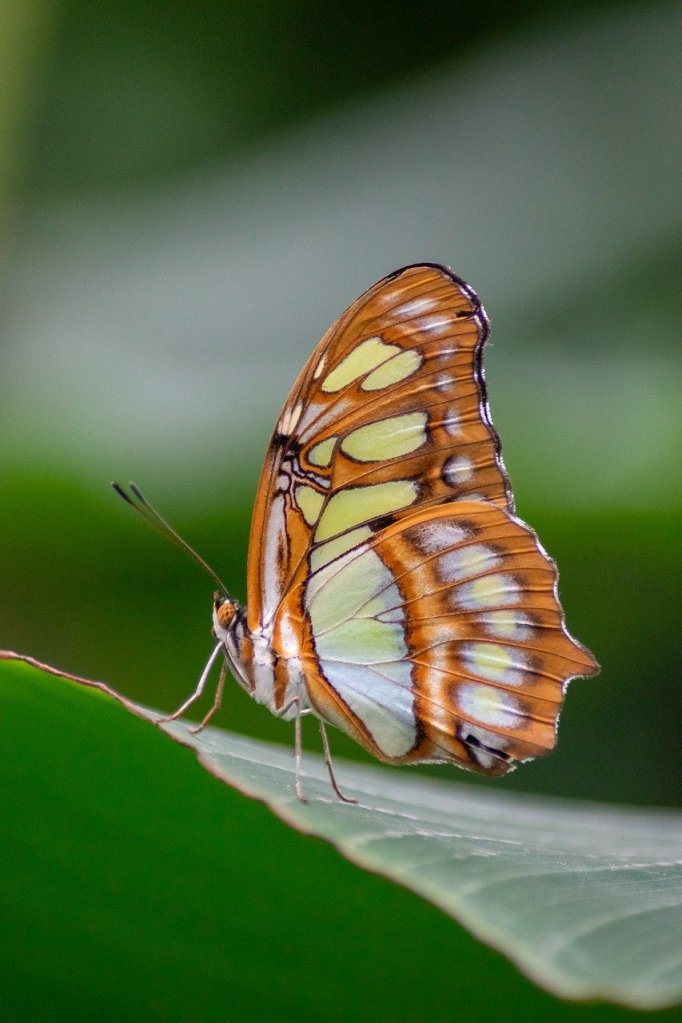
Butterflies are the beautiful insecta that begin as mere larva and transform into the winged creatures we have all come to love today. Why have we come to love butterflies so much? Could it be because of the taste receptors in their feet, the fact that they gain most of their nutrients from puddles of mud, or perhaps it’s because they are unable to fly in temperatures below 55 degrees Fahrenheit (Hadley, 2020). While those fun facts are quite riveting, I think we all know the real reason why the human brain might gravitate towards such a seemingly innocent creature. You see, butterflies carry something precious. They are translucent yet vibrant in color and help to identify any butterfly no matter the type. They use them to fly to great heights, hide in plain sight, and even war off predators that mistakenly see bright colors as a welcome sign. These luminous vessels are called wings.
Something many people may not know about butterfly wings is that they are actually transparent. Debbie Hadley in her article “10 Fascinating Facts About Butterflies” (2020) says, “We know butterflies as perhaps the most colorful, vibrant insects around! Well, a butterfly’s wings are covered by thousands of tiny scales, and these scales reflect light in different colors.” Think of it like a giant disco ball. A disco ball has thousands of tiny mirrors that reflect light causing it to create a nice lighting effect when it spins and, much like a disco ball, butterflies shine the brightest when they’re moving or when they’re flying. In the article “Where Do Butterflies Get Their Striking Colors?” Jennifer Horton says, “Butterflies possess some of the most striking color displays found in nature. As they fly from flower to flower gathering nectar, their brightly colored wings seem to shimmer and change colors before your eyes. Pilots flying above the rainforest can see the bright blues of the morpho butterfly of South America up to half a mile away.” Horton was able to not only identify the uniqueness of such colors in nature but also proved just how intense those colors can seem from as far as a mile away.
Another possible unknown fact about these creature’s eye-catching appendages is that in addition to them being used for camouflage, these colors are often seen as a warning. In the online web post “Facts About Butterfly Wings: Anatomy, Functions, Colors,” Anne Gilbertson explains, “Some butterflies use color to camouflage and become invisible to their predators.They do this by closing their wings and exposing the underside of the wings, which is typically dull. This helps them blend in with their surroundings without attracting attention…Some butterflies use color to threaten and keep off predators. This tactic is known as aposematism.” Butterflies will use the ventral side—or underside—of their wings as camouflage seeing as that part of the wing is often dull and colorless. While they use the dorsal side—or upper side—of their wings to mimic signs of a poisonous creature. I have come to find that a desperation to hide from predators might just be the exact answer I have been searching for to that all-encompassing question. What is the mystery behind the brilliance of a butterfly’s wing?
In their article “UV Photoreceptors and UV-Yellow Wing Pigments in Heliconius Butterflies Allow a Color Signal to Serve both Mimicry and Intraspecific Communication” Bybee and his coauthors explain, “Mimetic wing coloration evolves in butterflies in the context of predator confusion. In work on animal defenses, it is similarly unclear why aposematic signals involve colorful displays and strong contrasts. It may be that they are easily detected at the level of the predator’s photoreceptors, thereby also exploiting fixed sensory capacities.” (Bybee, et al., 2012). Bybee and his coauthors were not only able to analyze a butterfly’s wing color using certain light scales, but they were also able to find comparisons between such hypnotic displays of color and how the eyes of a predator may react. These researchers found that this incredible mystery was actually a long-evolved warning.
Every saturated red or jewel-toned blue that a butterfly ever displayed were all actually warning signs to predators to stay away, while all we saw was a personalized light show. Bybee also explains that most butterflies will have a 3-OHK pigmentation, meaning that this allows for the purest and most brilliant forms of colors to appear on a butterfly’s wings. This particular kind of pigmentation not only helps butterflies ward off predators, but it also allows them to change color at will. After making this discovery, I began to ponder what this actually means for our relationship with the butterflies. Can we really continue to look on at their beauty knowing that their radiant, inviting colors are actually one big red stop sign?
It seems Laura Tangley had the same thoughts as I. In her article “Butterfly Colors: Alluring or Alarming,” she writes, “Like two men shaking their fists and shouting, male butterflies may flash their brightly colored wings at each other as a sign of aggression. To explain the bright colors common to males of so many species, Silberglied suggests that color is used as a threat signal between males in conflict over a female.” (Tangley, 1982). It seems that these colors were not only warning signs to predators but to other butterflies as well. I suppose this once thrilling mystery is now turning into a rather violent realization. Unlike us humans, a butterfly’s rage can only be displayed in screaming color.
I suppose I can’t say I was disappointed by what I found regarding our butterfly friends; however I can’t say I’m not surprised either. I once saw butterflies as these almost ethereal beings; creatures that were created to please the eye and amaze the brain, but I think I’m beginning to see them for what they actually are: Normal, instinctual creatures that want for nothing but their own survival. I know myself and others once believed that these dancing colors were in fact signs from the universe, communicating the progress we were making on our journeys. There are actually entire articles dedicated to conveying the meaning behind wing colors like Joyce Elliot’s “Meaning of Butterfly Colors: 17 Remarkable Colors Explained,” for example.
Elliot, in her article, goes on to explain her deep fascination with butterfly wings and how these different shades and hues could offer significant insight into one’s own life. For example, she states that the black butterfly symbolizes mystery and transformation, black and blue butterflies carry the meaning of inner transformation and spiritual guidance, and that the blue butterfly “radiates a sense of tranquility, profound communication, and spiritual connection…” These are only a few symbols she mentions in her article, but I found each one to be more interesting than the last. The mystery of the butterfly wings seems to come with many answers. I suppose that’s why I felt compelled to share Elliot’s article and her belief because questions often come with set answers, but a mystery is too elusive and complex to only carry one conclusion.
Learning about this majestic and complex organism has been quite a journey. I set out to find an answer to what I had believed to be a simple question but was met with—as Dr. David Lees would phrase it— a “kaleidoscopic world” that changed shape just as I thought I had a clear image set up. So, what now? What should we do with this information? Should any of us even care about it? My answer to that is as complex as the butterflies. I suppose this information will only serve those of you who study butterflies for a living and the rest of you might walk away feeling as though you’ve wasted precious time reading about the translucent scales of a creature we hardly see anymore. I for one can understand such a notion but perhaps I can present you with another one.
Perhaps we can all see this information as eye-opening; life changing even. Seeing a butterfly after reading this article will surely never feel the same so why not embrace this change. Joyce Elliot in her article “Meaning of Butterfly Colors: 17 Remarkable Colors Explained” says that seeing a butterfly means you are going through some sort of transformation of change, and I believe that is what this whole article has been about. Opening your eyes to something new and perhaps changing your views for the better. What once was an innocent quest to find out more about a butterfly’s colorful accessory, turned into the discovery of a hidden truth and signs from the universe. When looking at all the information I have collected it seems heavy and confusing, but I can’t say it wasn’t fun. I suppose the mystery of the wing can be explained away by either UV light pigmentation or a message from spirit, but I choose to see this mystery as one that no one can solve. Maybe by looking at it that way we can continue to learn more about the butterflies and appreciate them as the radiant beings we have come to love them as.
 Science Writings